New Research – Overwhelmed and Oversubscribed: The Community Energy Fund’s Beginnings
Public demand for new community-led energy generation is outpacing government support offered through limited, short-term funding, a report from our charity partner, the Poverty and Environment Trust (PET), has found.
While the Community Energy Fund (CEF) has led to a small and incremental increase in the growth of community energy projects, modest funding restricted to a short time period is not sufficient to address the gap between the community energy sector’s actual generating capacity and its remarkable potential.
The CEF launched in January 2024 with £10 million in grant funding for community energy projects in England. The research assessed the rollout of the fund from its launch until March 2025, using data obtained from the Department for Energy Security and Net Zero, the Net Zero Hubs responsible for administering the fund, Community Energy England and participant community energy groups.
The Community Energy Fund - January 2024 to March 2025 - in Numbers
As of March 2025, £7.4 million of the fund’s £10 million total had been awarded. Of these grants, 95.1% had supported energy generation projects, with 4.9% for energy advice services.
The fund quickly became oversubscribed. For example, before its halfway point, the Greater South East Net Zero Hub had already awarded more grant funding than the £2 million sum allocated to that region for the fund’s entire two-year window.
76.1% of successful applications to the fund were for feasibility grants. These grants support technical and financial feasibility studies and community consultations required in the early stages of many projects.
Many groups, after receiving early-stage support, pursued a development grant from the CEF. For example, full data provided by the South West Net Zero Hub reveals that 56% of development grants in the region were awarded to projects that had previous funding from the CEF.
The research estimates £31,000 of CEF funding will support around 1 megawatt of new generation capacity. This suggests the total new generating capacity supported by the CEF could be up to 146 megawatts.
The research estimates that £10 million in CEF grants could leverage approximately £500 million in community investment.
Analysis and Recommendation
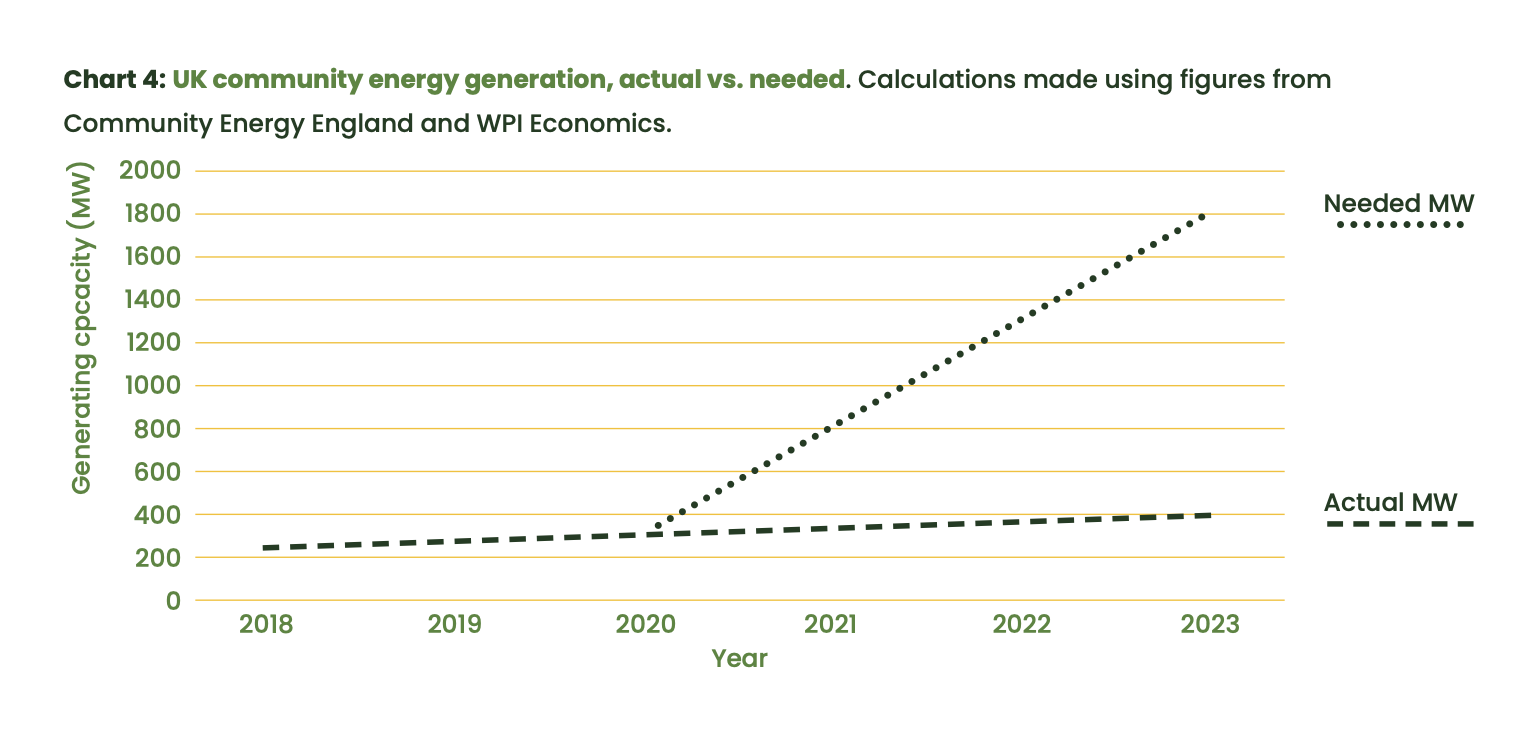
Considering that, in 2023, the community energy sector’s total generation capacity was 398 megawatts, 146 megawatts is a significant level of projected growth. However, this is not the whole picture.
In 2020, a study by WPI Economics calculated that the sector’s generating capacity has the potential to reach 5.2 gigawatts by 2030, requiring an average annual growth of 500 megawatts. So far, actual growth per year has remained at an average of just 26 megawatts. This disparity between actual and potential growth has not been effectively narrowed by the CEF. The estimated 146 megawatts of new generation capacity unlocked will also require further time and resources to take shape. Many projects remain at the feasibility stage, and multiple grants are often required for generation schemes to be realised. Ultimately, growth remains well below community energy’s remarkable potential.
With the CEF heavily oversubscribed and due to run out eight months before the end of the initial two-year window, the Department for Energy Security and Net Zero announced an extension on 21 March 2025. This will see an additional £5 million for projects in England, and £9.3 million of new funding for Scotland, Wales, and Northern Ireland. This will provide continuity of financial support and enable viable projects that were unable to access funding from the initial £10 million to receive finance, but it does not guarantee support for the sector for long.
Overwhelming public support, rapid uptake, and oversubscription to the CEF has demonstrated the nationwide appetite for new community energy projects. The report recommended that substantial regulatory reform, namely the introduction of a right to local supply for community energy schemes, is needed to unlock serious and sustained growth. This would make it possible for community energy groups to sell electricity generated by their schemes directly to local households and businesses in their areas. Whilst government funding has unlocked small incremental increases in the growth of community energy, this would no longer be needed if community energy groups were enabled to stand on their own two feet in the market.
Note: the Community Energy Fund was renamed the Great British Energy Community Fund in March 2025
Read the full report here