Government commit to local selling for community energy schemes
Tuesday 15th July was a momentous day for our campaign.
For more than half a decade, we have been advocating for a change in the law that would unlock the remarkable potential for growth in community energy.
Community energy is when smaller-scale renewable schemes, like rural wind farms or urban solar projects on schools and housing estates, are owned and run by local people. These schemes are not currently able to sell the power they generate directly to local homes and businesses, instead having to sell to big energy companies for a fraction of the price they could receive if selling locally. This makes it extremely difficult for communities to set up their own renewable energy schemes, and the result is there are hardly any in the UK.
A right to supply locally would enable community energy schemes to sell the clean power they generate directly to local homes and businesses. Communities across the UK would see the benefits of this through affordable bills, local jobs, climate safety and energy security.
On Tuesday, when asked about this, the Government said, “That is exactly what we are determined to do and we will continue to work to make it happen.”
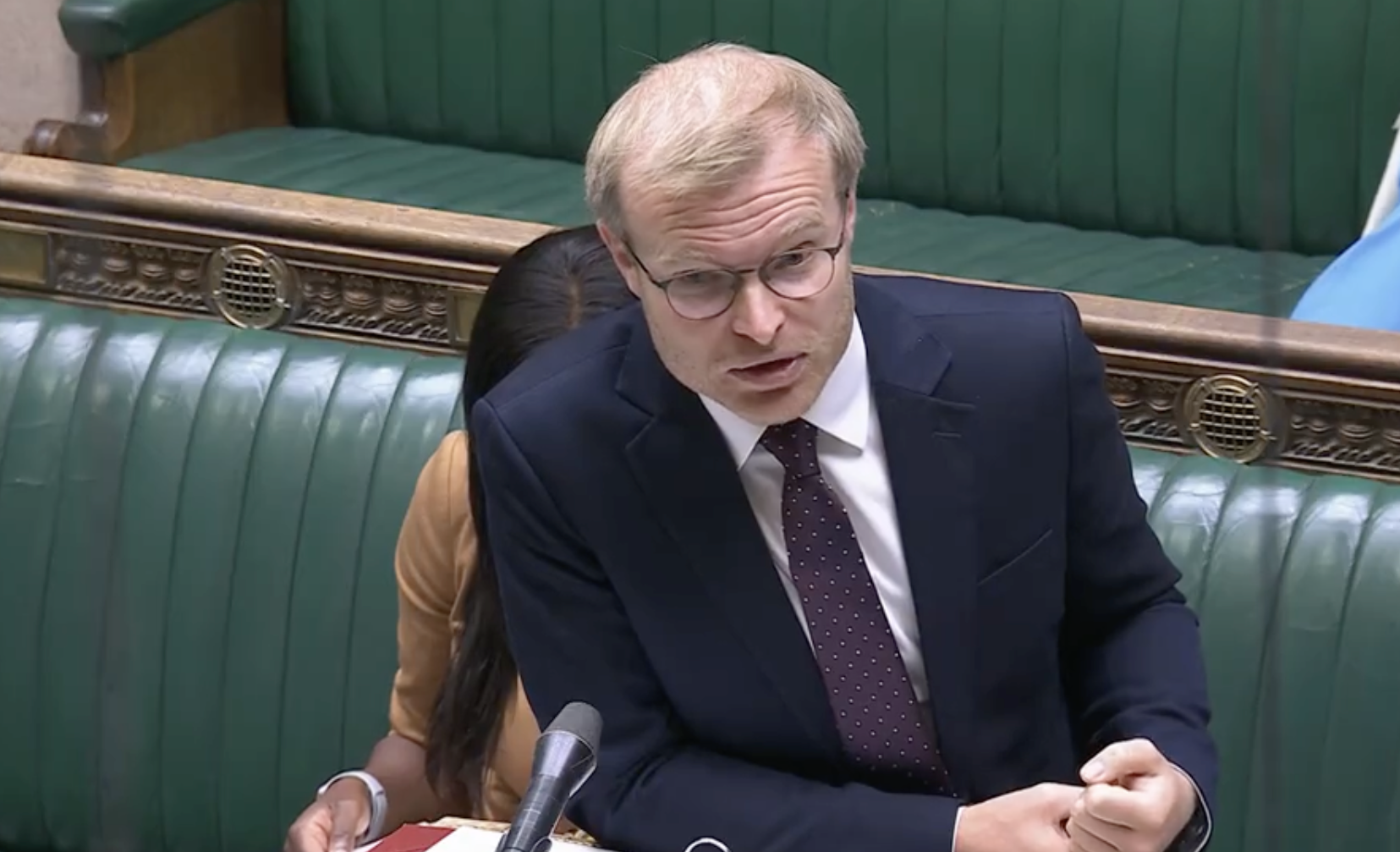
Michael Shanks MP, the Government Minister responsible for community energy, responding to Sir Jeremy Wright MP in the House of Commons on Tuesday 15th July
This was part of an exchange in the House of Commons, where Michael Shanks MP, the Government Minister responsible for community energy, answered a question from Sir Jeremy Wright MP. Here is what was said, in full:
Sir Jeremy Wright, Conservative MP for Kenilworth and Southam:
“The Minister will recognise that one way to increase the supply of clean energy is to enable community energy projects to supply local energy markets. When Ministers are asked about that, as he knows they have been many times, they generally say that there is no technical obstacle to it happening, but will the Minister recognise that there is a world of difference between, on the one hand, something being technically possible and, on the other, that same thing being facilitated and encouraged so it really happens? Will he focus on the latter as the Government develop their energy market reforms?”
Michael Shanks, Minister for Energy Security and Net Zero:
“I completely agree. The right hon. and learned Gentleman is absolutely right: there are no technical barriers to doing it, but that does not mean that it is a straightforward process. To be honest, things that I thought would have been much more straightforward, like how we define “community”, are more difficult to get right, but we are absolutely determined to do it. He is right to make the point about delivering clean power that benefits local communities, so that they can buy it locally and really see the benefit of hosting it. That is exactly what we are determined to do and we will continue to work to make it happen.”
Shortly after, Jess Brown-Fuller MP stood up and asked a similar question, to which the Energy Secretary of State, Ed Miliband MP, replied. Here is that exchange, in full:
Jess Brown-Fuller, Liberal Democrat MP for Chichester:
“Private sector investment via community energy schemes is a popular way of engaging people to get behind renewable energy projects in their area. A great example is Meadow Blue Community Energy in my constituency of Chichester, which puts money back into the community with a grant scheme and is now funding solar panels on local school roofs. Does the Secretary of State agree that community energy projects would attract more private sector investment if grid access costs were reduced and the delivery of local supply was made easier?”
Ed Miliband, Secretary of State for Energy Security and Net Zero:
“The hon. Lady raises an important issue, which was also raised by the right hon. and learned Member for Kenilworth and Southam (Sir Jeremy Wright). She is right about the virtues of community energy. Great British Energy is going to partner with local communities to deliver community energy up and down the country, because sometimes public capital—it could be loans, it could be grants—can help lever in the private capital that we need. She is also right about some of the barriers, as the Energy Minister mentioned. I want to assure her that we are going through the different barriers in granular, nerdy detail to see how we can break them down.”
We are delighted by this public confirmation from the Government, confirming they will enable local supply and are actively working to make it a reality.
This unequivocal commitment is a result of a steady build up of support for community energy within Parliament. Under the previous Government, we brought over 320 MPs on board to back our Local Electricity Bill, a proposed law that would make it possible for community energy schemes to sell locally. This led to the establishment of the Community Energy Fund, a £10 million pot of funding for community energy projects in England. After Labour became the Government last year, we campaigned to see community energy included in the Great British Energy Act. We succeeded, meaning that smaller-scale renewable schemes can now benefit from the £8 billion that Great British Energy – a new publicly owned clean energy company – is set to spend on renewables across the next few years. Then, in March this year, we secured an additional £14.3 million in community energy funding, including for projects in Scotland, Wales and Northern Ireland.
We have always maintained that the single most effective change needed for community energy to grow is to allow groups to sell the electricity they generate directly to local people. So the Government’s statement this week was excellent news.
What now?
Our campaign continues. We intend to make sure that the new local supply process is effective and implemented promptly.
Over the coming months we will work with energy systems experts and the community energy sector on developing the detail of the mechanism to enable local supply. We will also call on the Government to provide more details with regards to their plans, such as when they intend for local supply to come into effect.
Finally, here is a short video that helps show how effective our collective efforts have been over the years:
If you have not already signed up for updates and calls to action, please do so here.